


How to Choose the Right Roofing Material for Your Home
The right roofing material is the material that fits the roof structure and slope, meets the applicable code and manufacturer instructions, is available as a complete installed system, and matches the homeowner's priorities for weather performance,…
Discuss your project
The right roofing material is the material that fits the roof structure and slope, meets the applicable code and manufacturer instructions, is available as a complete installed system, and matches the homeowner's priorities for weather performance, maintenance, repairability, appearance, and budget. No roofing material is best for every home, and a product label by itself does not establish how the finished roof will perform.
Start with the roof, then compare materials
A roof covering works with the deck, underlayment, flashing, ventilation, fasteners, starter material, hips, ridges, penetrations, and drainage details. FEMA's December 2010 wind-retrofit guide stresses product ratings, manufacturer installation details, fastening, and the roof system around the covering. A material comparison should therefore start with the existing roof and the proposed installed scope.
Before comparing colors or warranty labels, confirm these facts:
- Roof slope, geometry, deck condition, and any structural limitation.
- Applicable code and the manufacturer's approved installation method.
- Wind, impact, and fire classifications for the exact product and assembly.
- The underlayment, flashing, ventilation, starter, hip, ridge, and attachment components included in the proposal.
- Product availability, future repairability, and the documentation the manufacturer or insurer requires.
How do the main roofing-material families differ?
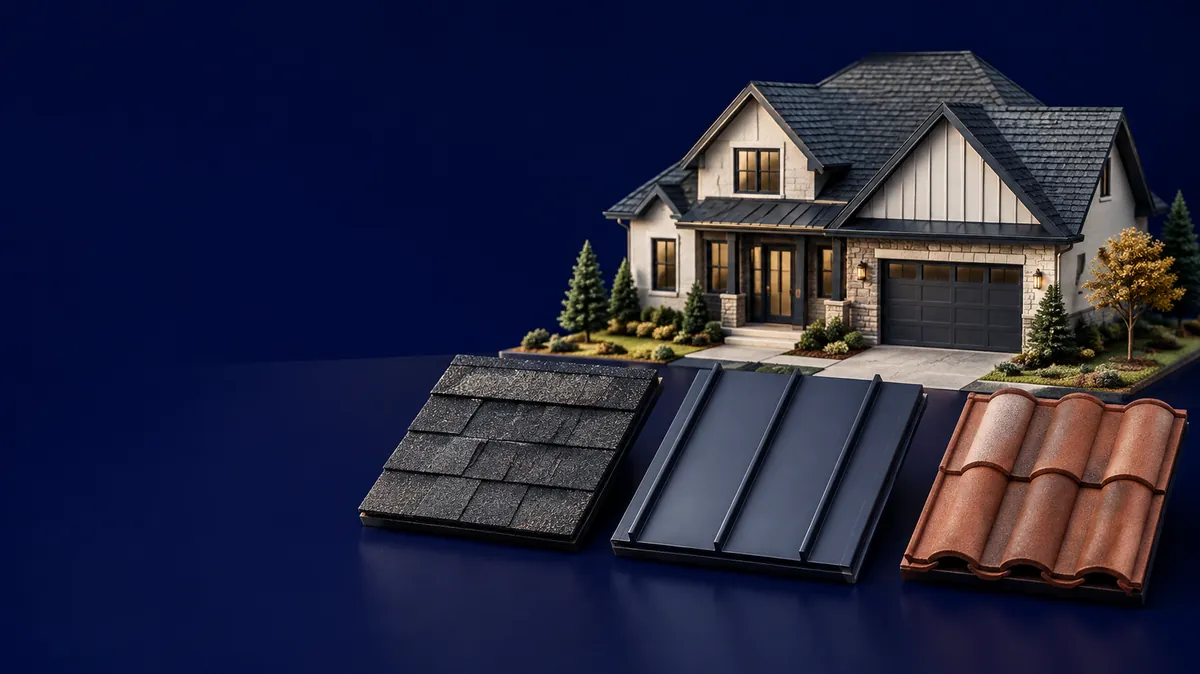
Each material family can contain products with different ratings, installation methods, finishes, and warranty terms. Compare the exact proposed product and roof system rather than assigning one set of claims to every asphalt, metal, tile, wood, or slate roof.
| Material family | Useful early questions | What must be verified in the proposal |
|---|---|---|
| Asphalt shingles | Which product line, impact class, wind classification, color, and repair method fit the roof? | Exact shingle, accessories, nailing pattern, underlayment, ventilation, availability, and warranty documents |
| Metal roofing | Which panel profile, coating, attachment method, and flashing details apply? | Substrate, clips or fasteners, seams, penetrations, corrosion exposure, finish, repair method, and installer requirements |
| Clay or concrete tile | Can the existing structure and deck support the proposed system, and how will tiles be attached? | Structural review where needed, tile profile, attachment, underlayment, flashing, replacement-tile supply, and access limits |
| Wood shingles or shakes | Does the product and assembly satisfy the applicable fire, moisture, and maintenance requirements? | Product classification, treatment, underlayment, ventilation, fastening, maintenance, and local code acceptance |
| Slate | Can the structure support the proposed system, and can compatible replacement pieces and qualified repair work be obtained? | Structural review where needed, slate type, attachment, flashing, installer experience, access, and future repair supply |
The table is a screening tool. A written proposal still needs the exact product documents and a complete scope.
What do wind and impact ratings tell you?
Wind and impact ratings answer different questions. The same FEMA guide notes that a shingle warranty is not a wind-resistance rating and recommends selecting products and installation details for the design wind requirements at the property. The wind classification, fastening pattern, roof edges, starter material, deck attachment, and sealed-roof details all need separate review.
UL 2218 uses four impact-resistance classes based on defined laboratory impacts. Class 4 is the highest class in that standard, but UL Solutions explains that the test does not account for every visible form of damage, including some denting and granule loss. A Class 3 or Class 4 label should not be translated into a hail-proof claim or a promise that a particular roof will avoid damage.
The broad material decision still depends on the complete roof system and the property's conditions. Ask for the exact product test documents and installation instructions when comparing impact-rated shingles.
Can a reflective roof lower cooling demand?
Reflectance is one factor in a roof decision, especially in a hot climate. The U.S. Department of Energy says cooling effects depend on climate, roof type, insulation, and the heating and cooling system. The Department of Energy also identifies solar reflectance, sustained reflectance, and thermal emittance as the material properties to examine.
A reflective label does not support a universal savings percentage or payback period. Compare the exact product rating with the home's insulation, attic or roof assembly, HVAC performance, utility costs, shade, and heating needs before assigning an economic value.
How should cost be compared?
Compare installed scopes on the same roof, not a material name or unit price by itself. One proposal may include decking allowances, upgraded underlayment, ventilation corrections, flashing replacement, disposal, permits, accessories, and a defined change-order process while another leaves those items open.
Ask each contractor to identify:
- The exact roof covering and accessory products.
- Tear-off, disposal, deck inspection, and deck-repair allowances.
- Underlayment, flashing, ventilation, edge, starter, hip, and ridge work.
- Permit, code, and inspection responsibility.
- Exclusions, concealed conditions, and the change-order process.
- Manufacturer and workmanship warranty documents.
- The payment schedule and any financing terms in separate current disclosures.
This article does not give a price range because roof size, geometry, deck condition, material, market, and scope have not been established for a particular project.
The seven-factor roof decision
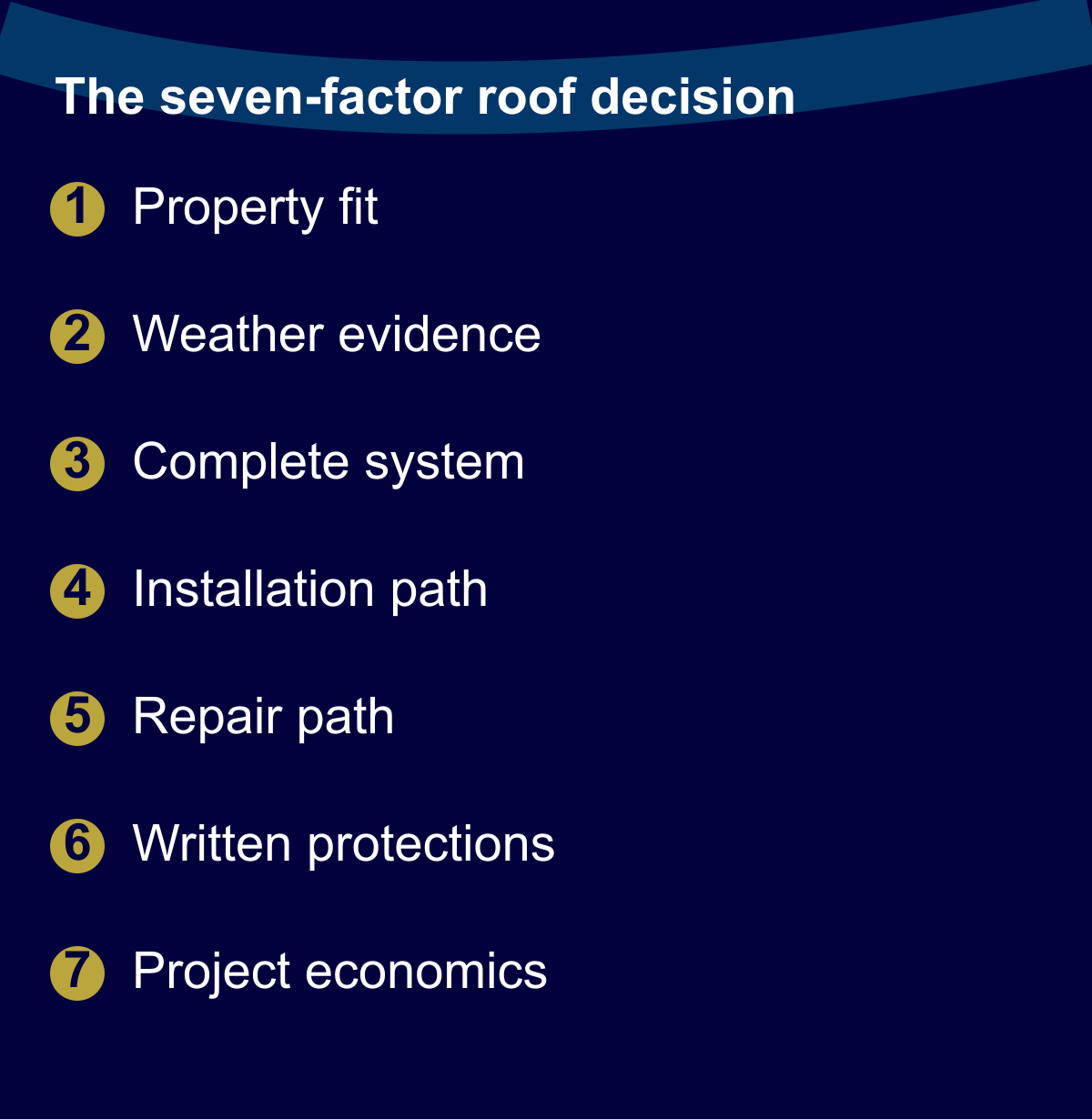
- Property fit
- Weather evidence
- Complete system
- Installation path
- Repair path
- Written protections
- Project economics
What is the PHS Roof-Material Decision Screen?
Pinnacle's seven-factor screen keeps the material decision tied to the property and the written proposal:
- Property fit: Confirm slope, geometry, deck condition, structural limits, penetrations, drainage, and access.
- Weather evidence: Review separate wind, impact, fire, reflectance, and moisture-related product evidence that applies to the exact roof.
- Complete system: List the covering, underlayment, flashing, ventilation, starter, hips, ridges, edges, fasteners, and required accessories.
- Installation path: Match the proposed method to the manufacturer instructions, applicable code, and site conditions.
- Repair path: Confirm how a damaged area could be repaired and whether compatible material is likely to remain obtainable.
- Written protections: Read the warranty terms, exclusions, registration steps, transfer rules, and maintenance conditions.
- Project economics: Compare the full installed scope, exclusions, future repair considerations, and any insurer paperwork. Do not count an unconfirmed discount or savings estimate.
This screen does not select a product before the roof and project are reviewed. It shows the evidence that should appear in a recommendation.
Match the evidence to the property
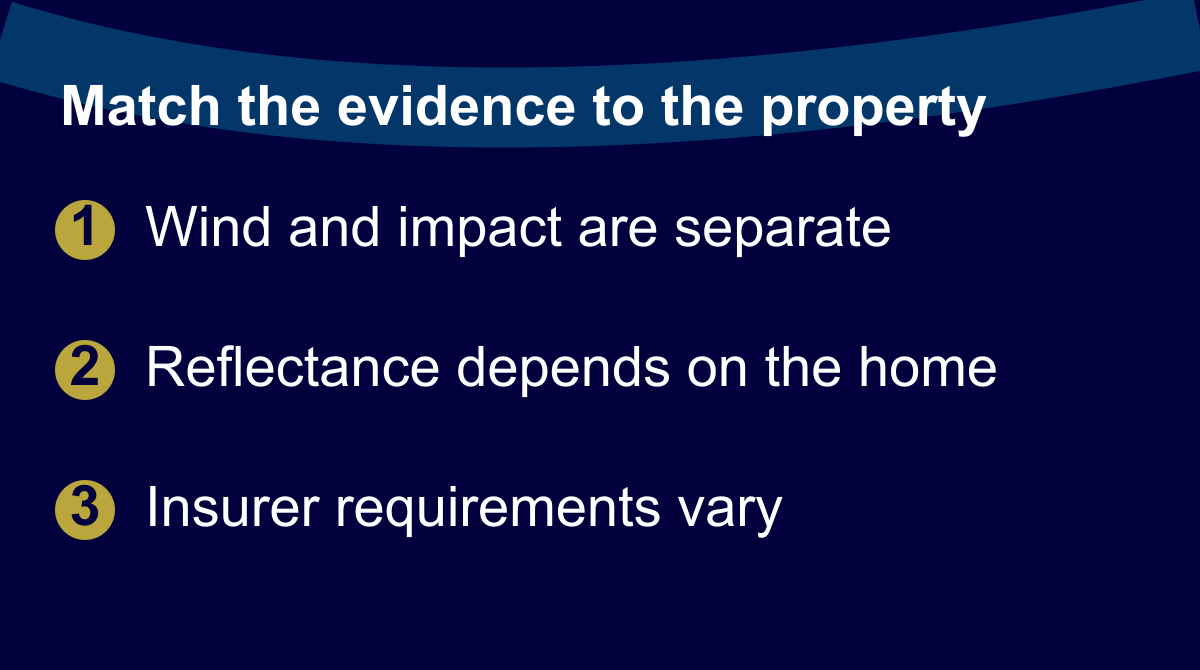
- Wind and impact are separate
- Reflectance depends on the home
- Insurer requirements vary
What should DFW homeowners compare?
For a DFW home, compare wind and impact classifications, complete-system installation details, reflectance, attic and ventilation conditions, product availability, repairability, and insurer paperwork. Texas Department of Insurance guidance says each insurer decides which impact test criteria, labels, forms, and credit amounts it accepts. The department does not endorse a roofing material.
Pinnacle's current DFW working direction is generally within about 50 miles of DFW International Airport, subject to ZIP code and project confirmation. That working direction does not guarantee that every address, product, or project will be accepted.
What should Fort Wayne-area homeowners compare?
Fort Wayne homeowners should compare the same product and system evidence while accounting for local temperature changes, winter precipitation, wind, and severe-weather exposure. The National Weather Service's Fort Wayne climate record documents both winter conditions and severe-weather risk, but the regional climate does not select one material for every property.
Pinnacle's current Fort Wayne working direction is generally within about 50 miles of downtown Fort Wayne, subject to ZIP code and project confirmation. This is regional intake language and does not represent statewide Indiana coverage or local product availability.
Can impact-resistant roofing lower an insurance premium?
Possibly, if the insurer accepts the exact product, installation, labeling, and paperwork. The Texas Department of Insurance says insurers establish their own credits and required documentation. It also states that the department does not endorse or recommend a roofing material.
Ask the insurer in writing about the manufacturer, product, impact class, installation address, required form, policy endorsement, and credit before including a discount in the purchase decision. Indiana treatment should be confirmed with the homeowner's insurer and policy because this article does not establish a state-required credit.
Which roofing material should you choose?
Choose after the proposal identifies the roof conditions, exact product, complete system, installation method, ratings, repair path, warranty documents, and total installed scope. A broad statement that one material lasts longest, costs least, saves the most energy, or handles every storm removes the property and installation evidence needed for a reliable decision.
Pinnacle can review the ZIP code, roof concern, material under consideration, and project timing before confirming whether the project fits its DFW or Fort Wayne regional work. Product availability, scope, and final recommendations are confirmed for the individual property.
CTA label: Compare Roofing Materials for Your Home CTA support copy: Tell us your ZIP code, roof concern, material under consideration, and project timing. Pinnacle will confirm project fit and the next step before recommending a roof system. CTA destination: /contact-us/
Frequently asked questions
Is metal roofing always better than asphalt shingles?
No material is always better for every property. Compare the exact products, roof fit, installation, ratings, repair path, complete scope, and budget.
Does a Class 4 rating make a shingle hail-proof?
No. Class 4 is the highest impact class under UL 2218, but it is a laboratory rating and does not guarantee that a roof will avoid hail damage.
Does a roof warranty show how the roof will perform in wind?
No. FEMA states that warranty duration is not a wind-resistance rating. Review the exact wind classification and required installation details.
Can a cool roof guarantee lower energy bills?
No. The Department of Energy says the result depends on the climate, roof, insulation, and heating and cooling system. Use the exact product rating and property conditions before estimating savings.
Should insurance savings decide the roofing material?
Only after the insurer confirms the exact product, installation, policy treatment, required paperwork, and credit. No discount is assumed in this guide.